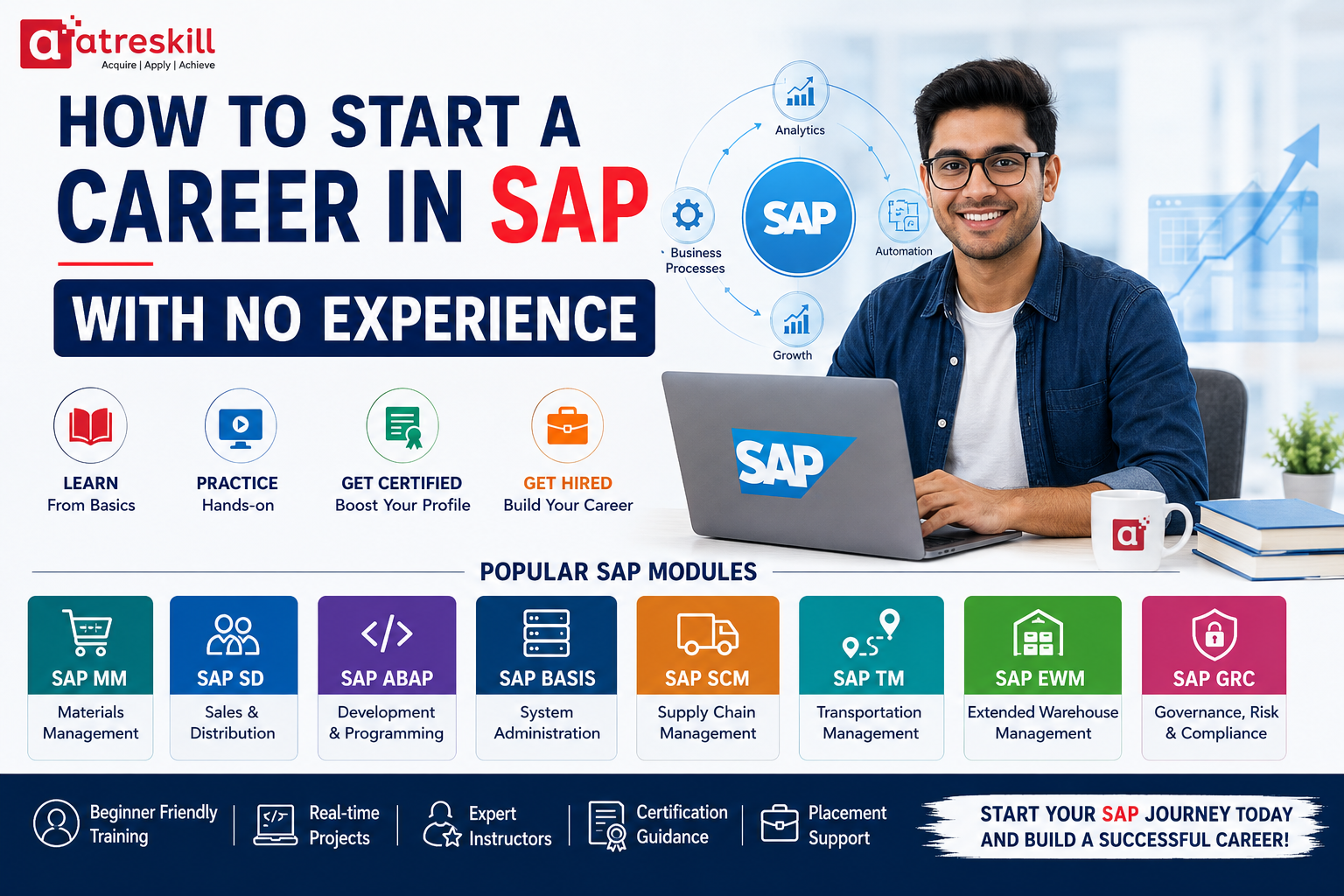
The demand for SAP professionals continues to grow as organizations worldwide adopt SAP solutions to streamline business operations. One of the biggest misconceptions among beginners is that they need prior experience to start a career in SAP. The reality is that many successful SAP consultants began their journey with no industry experience and built their careers through proper training and hands-on learning.
Whether you are a fresher, graduate, working professional, or someone looking for a career switch, SAP offers multiple career paths that can lead to excellent job opportunities and attractive salary packages.
In this guide, we will explain how to start a career in SAP with no experience and help you understand the most popular SAP modules available today.
What is SAP?
SAP (Systems, Applications, and Products in Data Processing) is one of the world’s leading Enterprise Resource Planning (ERP) software solutions. It helps businesses manage various operations such as finance, procurement, sales, logistics, human resources, manufacturing, and compliance.
Today, SAP solutions are used by organizations across industries including:
- Manufacturing
- Retail
- Healthcare
- Banking
- Logistics
- Automotive
- E-commerce
- Telecommunications
As companies continue to digitize their operations, the demand for SAP professionals remains high.
Can You Learn SAP Without Experience?
Yes.
Many SAP training programs are specifically designed for beginners. With the right learning approach, practical training, and project exposure, anyone can start an SAP career.
Basic Requirements
- Basic computer knowledge
- Interest in business processes
- Willingness to learn ERP systems
- Good communication skills
No programming background is required for functional modules.
Step-by-Step Guide to Start a Career in SAP
Step 1: Understand Different SAP Modules
SAP offers multiple modules for different business functions.
Choose a module based on your educational background, career goals, and interests.
Popular SAP Modules and Career Opportunities
| SAP Module | Focus Area | Best For |
| SAP MM | Procurement & Inventory | Supply Chain Professionals |
| SAP SD | Sales & Distribution | Sales & Marketing Professionals |
| SAP ABAP | SAP Development | Programmers & Developers |
| SAP BASIS | SAP Administration | IT Infrastructure Professionals |
| SAP SCM | Supply Chain Management | Logistics & Operations Experts |
| SAP TM | Transportation Management | Logistics Professionals |
| SAP EWM | Warehouse Management | Warehouse & Supply Chain Teams |
| SAP GRC | Governance & Compliance | Security & Audit Professionals |
SAP MM (Materials Management)
What is SAP MM?
SAP MM manages procurement, purchasing, inventory management, and material planning.
Key Topics
- Purchase Requisition
- Purchase Order
- Vendor Management
- Inventory Management
- Material Master
Career Opportunities
- SAP MM Consultant
- Procurement Consultant
- Inventory Analyst
Professionals interested in procurement and supply chain operations often start with a SAP MM Online Course.
SAP SD (Sales and Distribution)
What is SAP SD?
SAP SD manages customer sales processes, order management, billing, and shipping activities.
Key Topics
- Sales Order Processing
- Customer Master Data
- Pricing Configuration
- Billing
- Shipping
Career Opportunities
- SAP SD Consultant
- Sales Process Analyst
- Order Management Specialist
A SAP SD Online Course is ideal for professionals interested in sales and customer management.
SAP ABAP (Advanced Business Application Programming)
What is SAP ABAP?
SAP ABAP is the programming language used to develop and customize SAP applications.
Key Topics
- Reports
- Smart Forms
- Adobe Forms
- Enhancements
- Interfaces
Career Opportunities
- SAP ABAP Developer
- Technical Consultant
- SAP Programmer
A SAP ABAP Online Course helps developers build technical expertise in SAP environments.
SAP BASIS
What is SAP BASIS?
SAP BASIS is the technical foundation of SAP systems. It focuses on system administration, installation, monitoring, and performance management.
Key Topics
- SAP Installation
- User Administration
- System Monitoring
- Transport Management
- Database Administration
Career Opportunities
- SAP BASIS Consultant
- SAP Administrator
- Technical Support Engineer
A SAP BASIS Online Course is suitable for IT infrastructure professionals.
SAP SCM (Supply Chain Management)
What is SAP SCM?
SAP SCM helps businesses optimize supply chain planning and execution.
Key Topics
- Demand Planning
- Supply Network Planning
- Production Planning
- Logistics Coordination
Career Opportunities
- SAP SCM Consultant
- Supply Chain Analyst
- Logistics Planner
Many learners choose a SAP SCM Course to enter the growing supply chain sector.
SAP TM (Transportation Management)
What is SAP TM?
SAP TM helps organizations manage transportation planning, freight management, and logistics execution.
Key Topics
- Freight Planning
- Carrier Selection
- Transportation Execution
- Freight Settlement
Career Opportunities
- SAP TM Consultant
- Transportation Planner
- Logistics Coordinator
A SAP TM Online Course can help professionals build expertise in transportation and logistics operations.
SAP EWM (Extended Warehouse Management)
What is SAP EWM?
SAP EWM is an advanced warehouse management solution that optimizes warehouse operations.
Key Topics
- Warehouse Structure
- Inbound Processing
- Outbound Processing
- Inventory Management
- RF Framework
Career Opportunities
- SAP EWM Consultant
- Warehouse Analyst
- Inventory Specialist
Professionals interested in warehouse operations can benefit from a SAP EWM Course Online.
SAP GRC (Governance, Risk, and Compliance)
What is SAP GRC?
SAP GRC helps organizations manage governance, risk, compliance, and security processes.
Key Topics
- Access Control
- Risk Management
- Process Control
- Audit Management
- Segregation of Duties (SoD)
Career Opportunities
- SAP GRC Consultant
- Compliance Analyst
- Risk Management Specialist
A SAP GRC Online Course is highly recommended for professionals interested in compliance and cybersecurity.
How to Choose the Right SAP Module
| Educational Background | Recommended SAP Module |
| B.Com / M.Com | SAP FICO |
| MBA Marketing | SAP SD |
| MBA Operations | SAP MM, SAP SCM |
| B.Tech / MCA | SAP ABAP, SAP BASIS |
| Logistics Professionals | SAP TM, SAP EWM |
| Security Professionals | SAP GRC |
Step 2: Enroll in a SAP Course Online
A professional SAP Course Online provides:
- Live Instructor-Led Training
- Real-Time Projects
- Hands-On Practice
- Certification Guidance
- Placement Support
Online learning allows students and working professionals to learn at their own pace.
Step 3: Gain Practical Experience
Experience is important, but it can be developed through:
- Training Projects
- Case Studies
- SAP Sandbox Practice
- Internship Programs
- Mock Implementations
Practical exposure helps build confidence and interview readiness.
Step 4: Build SAP Certification Skills
SAP certifications validate your knowledge and increase credibility among employers.
Benefits include:
- Better Job Opportunities
- Higher Salary Potential
- Global Recognition
- Professional Growth
Step 5: Prepare for SAP Interviews
Focus on:
- Business Process Understanding
- Module-Specific Concepts
- Real-Time Scenarios
- Communication Skills
- Problem-Solving Abilities
Interview preparation significantly improves placement success.
Future Scope of SAP Careers
SAP continues to dominate the ERP market and is expanding rapidly through:
- SAP S/4HANA
- SAP Business AI
- Cloud ERP
- Digital Supply Chains
- Intelligent Automation
As organizations modernize their systems, SAP professionals will remain in high demand across industries worldwide.
Conclusion
Starting a career in SAP without experience is entirely possible with the right learning path and dedication. The first step is choosing a module that aligns with your interests and educational background.
Whether you select a SAP MM Online Course, SAP ABAP Online Course, SAP BASIS Online Course, SAP SD Online Course, SAP SCM Course, SAP TM Online Course, SAP EWM Course Online, or SAP GRC Online Course, gaining practical knowledge and hands-on experience can open the door to rewarding career opportunities.
Investing in a quality SAP Course Online can help you develop industry-relevant skills, earn certifications, and build a successful future in the SAP ecosystem.
Frequently Asked Questions (FAQs)
Can I start a career in SAP without any experience?
Yes, you can start a career in SAP without prior experience. Many beginners join a SAP Course Online to learn business processes, gain hands-on practice, and prepare for entry-level SAP consultant roles.
Which SAP module is best for freshers?
The best SAP module depends on your educational background and career goals. Freshers often choose SAP MM, SAP SD, SAP ABAP, SAP BASIS, SAP SCM, SAP TM, SAP EWM, or SAP GRC based on their interests and skills.
Is SAP certification necessary to get a job?
SAP certification is not always mandatory, but it can improve your credibility, increase job opportunities, and help you stand out during the hiring process.
What is SAP MM and who should learn it?
SAP MM (Materials Management) focuses on procurement and inventory management. A SAP MM Online Course is ideal for professionals working in purchasing, inventory control, and supply chain management.
Is SAP ABAP a good career option for programmers?
Yes. SAP ABAP is one of the most popular technical modules in SAP. A SAP ABAP Online Course helps developers learn SAP programming, reports, forms, enhancements, and interfaces.
What does SAP BASIS do?
SAP BASIS is responsible for SAP system administration, installation, monitoring, and maintenance. A SAP BASIS Online Course is suitable for IT infrastructure and system administration professionals.
What are the career opportunities after a SAP SD Online Course?
After completing a SAP SD Online Course, professionals can work as SAP SD Consultants, Sales Process Analysts, Customer Service Specialists, and Order Management Consultants.
What is SAP SCM and why is it important?
SAP SCM (Supply Chain Management) helps organizations optimize planning, procurement, production, and logistics processes. A SAP SCM Course is valuable for professionals interested in supply chain operations.
What is SAP TM used for?
SAP TM (Transportation Management) helps companies manage freight planning, transportation execution, carrier management, and logistics operations. A SAP TM Online Course is ideal for logistics professionals.
11. What is SAP EWM and how is it different from traditional warehouse management?
SAP EWM (Extended Warehouse Management) provides advanced warehouse management capabilities such as real-time inventory tracking, warehouse automation, and labor management. A SAP EWM Course Online helps professionals develop expertise in warehouse operations.
What is SAP GRC and who should learn it?
SAP GRC (Governance, Risk, and Compliance) helps organizations manage risk, security, and regulatory compliance. A SAP GRC Online Course is suitable for compliance professionals, auditors, cybersecurity experts, and SAP security consultants.
Which SAP module offers the highest salary?
Salary depends on experience, industry, and location. Modules such as SAP GRC, SAP EWM, SAP TM, SAP SCM, SAP ABAP, and SAP S/4HANA-related specializations often offer strong career growth and competitive salaries.
Can I learn SAP online while working?
Yes. Most training institutes offer flexible SAP Course Online programs with live classes, recorded sessions, and weekend batches designed for working professionals.
15. What is the future scope of SAP careers in 2026 and beyond?
The future of SAP is very promising due to increasing adoption of SAP S/4HANA, cloud ERP, AI-driven business processes, digital supply chains, and enterprise automation. Skilled SAP professionals are expected to remain in high demand globally.