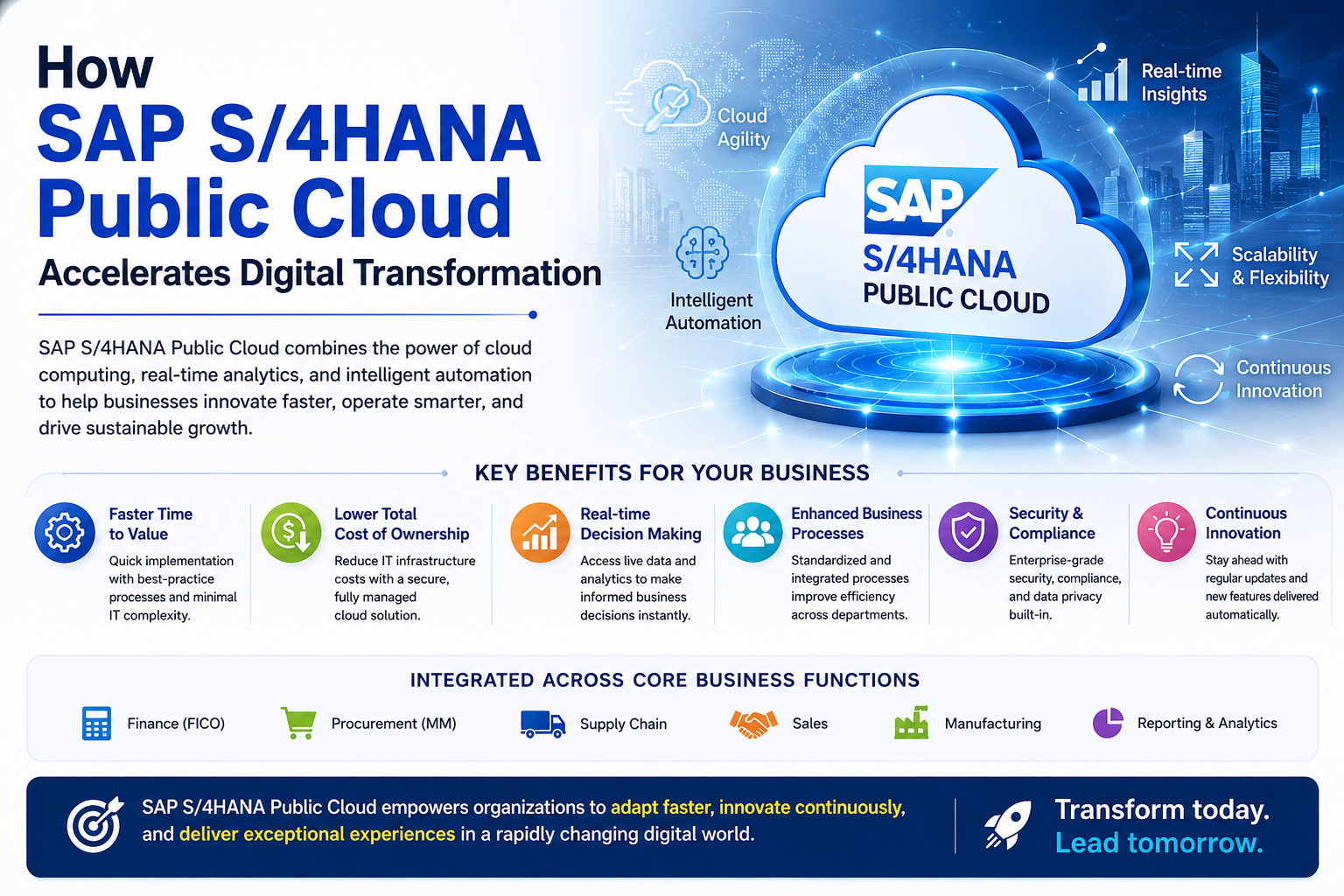
Digital transformation has become a strategic priority for organizations seeking to improve operational efficiency, enhance customer experiences, and respond quickly to changing market conditions. Traditional ERP systems, while reliable, often struggle to keep pace with rapidly evolving business requirements due to complex customizations, lengthy upgrade cycles, and high infrastructure costs.
SAP S/4HANA Public Cloud addresses these challenges by delivering a modern, cloud-native ERP platform that combines intelligent automation, real-time analytics, industry best practices, and continuous innovation. Designed as a Software-as-a-Service (SaaS) solution, it enables businesses to accelerate transformation while reducing IT complexity and total cost of ownership.
we’ll explore how SAP S/4HANA Public Cloud helps organizations modernize operations and achieve sustainable digital transformation.
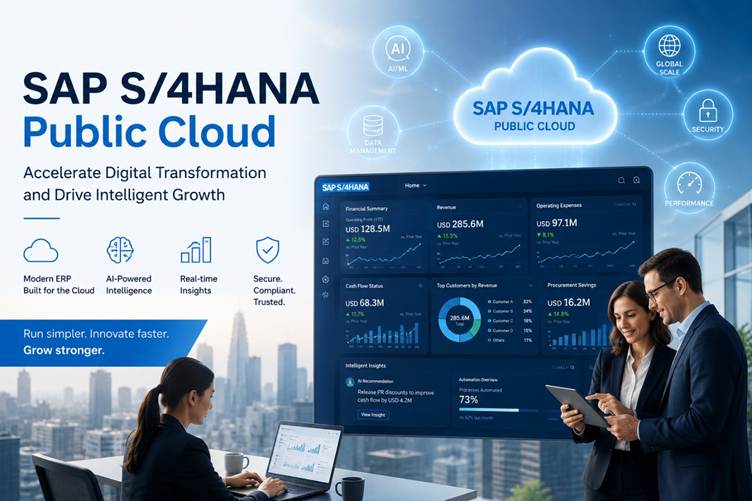
What is SAP S/4HANA Public Cloud?
SAP S/4HANA Public Cloud is SAP next-generation cloud ERP solution built on the SAP HANA in-memory database. SAP Course provides standardized business processes across finance, procurement, sales, manufacturing, supply chain, human resources integration, and project management.
Unlike traditional on-premise ERP systems, the Public Cloud edition offers:
- Rapid deployment
- Automatic quarterly updates
- Embedded AI and machine learning
- Real-time analytics
- Best-practice business processes
- High scalability
- Lower infrastructure and maintenance costs
Organizations can focus more on innovation and less on managing complex IT environments.
Why Organizations are Moving to Cloud ERP
Today’s businesses face several challenges:
- Increasing customer expectations
- Global supply chain disruptions
- Rising operational costs
- Regulatory compliance requirements
- Demand for real-time business insights
- Faster innovation cycles
Legacy ERP systems often require expensive hardware upgrades, lengthy implementation projects, and manual maintenance activities.
SAP S/4HANA Public Cloud eliminates these obstacles by providing a flexible, continuously updated ERP platform accessible from anywhere.
Key Ways SAP S/4HANA Public Cloud Accelerates Digital Transformation
1. Faster Implementation with Best Practices
One of the biggest advantages is accelerated implementation.
SAP provides preconfigured business processes based on industry best practices. Organizations no longer need to design every process from scratch.
Benefits include:
- Reduced implementation timelines
- Lower project costs
- Minimal customization
- Faster user adoption
- Reduced project risks
Companies can go live in months instead of years.
2. Continuous Innovation Through Automatic Updates
Traditional ERP upgrades are often expensive and disruptive.
SAP S/4HANA Public Cloud delivers:
- Quarterly feature releases
- Security enhancements
- Performance improvements
- Compliance updates
- New AI capabilities
Businesses automatically receive the latest innovations without major upgrade projects.
This allows IT teams to focus on strategic initiatives instead of system maintenance.
3. Real-Time Analytics for Better Decision Making
Digital transformation depends on data-driven decision-making.
SAP HANA’s in-memory architecture enables:
- Real-time reporting
- Instant financial insights
- Live inventory visibility
- Predictive forecasting
- Operational dashboards
Decision-makers no longer wait hours—or days—for reports.
Instead, they gain immediate access to business-critical information.
4. Embedded Artificial Intelligence and Automation
SAP S/4HANA Public Cloud includes intelligent technologies that automate repetitive business processes.
Examples include:
- Invoice processing automation
- Intelligent cash application
- Predictive maintenance
- Demand forecasting
- Automated purchase recommendations
- AI-assisted financial reconciliation
Automation reduces manual effort, improves accuracy, and increases employee productivity.
5. Improved Business Agility
Market conditions change rapidly.
Organizations need systems capable of adapting quickly.
SAP S/4HANA Public Cloud enables businesses to:
- Launch new products faster
- Expand into new markets
- Support mergers and acquisitions
- Scale operations globally
- Respond quickly to changing customer demands
Cloud scalability allows businesses to increase or decrease resources without infrastructure investments.
6. Enhanced User Experience
Employee productivity improves when systems are easy to use.
SAP S/4HANA Public Cloud leverages the SAP Fiori user experience, offering:
- Role-based dashboards
- Responsive design
- Mobile accessibility
- Personalized workspaces
- Simplified navigation
Users can complete tasks more efficiently from desktops, tablets, or smartphones.
7. Integrated End-to-End Business Processes
Digital transformation requires connected business operations.
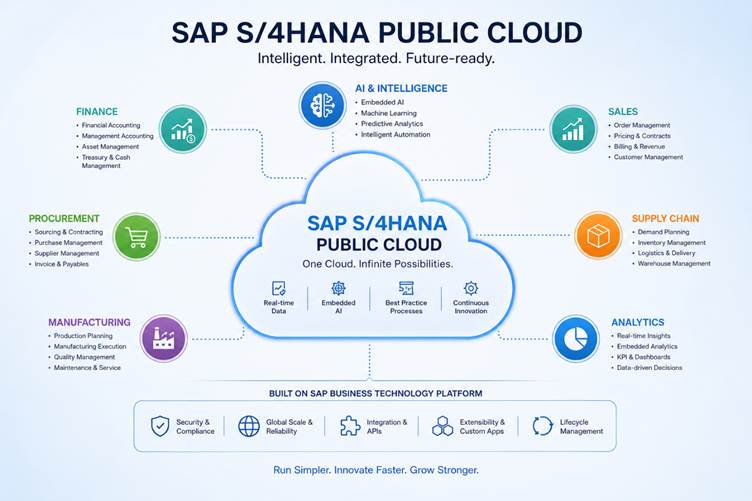
SAP S/4HANA Public Cloud integrates multiple business functions, including:
Finance
- General Ledger
- Accounts Payable
- Accounts Receivable
- Asset Accounting
- Financial Planning
- Group Reporting
Procurement
- Supplier management
- Purchase requisitions
- Purchase orders
- Invoice processing
- Contract management
Sales
- Quote-to-Cash
- Order management
- Pricing
- Billing
- Customer management
Supply Chain
- Inventory management
- Warehouse operations
- Production planning
- Logistics
- Demand planning
This integration eliminates data silos and improves collaboration across departments.
8. Built-In Security and Compliance
Security remains a top concern for cloud adoption.
SAP S/4HANA Public Cloud offers enterprise-grade security features, including:
- Identity and access management
- Data encryption
- Secure authentication
- Audit logging
- Regulatory compliance support
- Continuous security monitoring
Organizations benefit from robust security without managing complex infrastructure themselves.
9. Lower Total Cost of Ownership (TCO)
Traditional ERP systems often incur high costs for:
- Hardware
- Database licenses
- Infrastructure maintenance
- Upgrade projects
- Backup management
- Disaster recovery
With SAP S/4HANA Public Cloud, organizations benefit from:
- Subscription-based pricing
- No hardware investments
- Reduced IT administration
- Automatic maintenance
- Lower operational expenses
The predictable cost model supports long-term financial planning.
10. Support for Intelligent Enterprise Strategy
SAP’s vision of the Intelligent Enterprise is enabled through integration with technologies such as:
- SAP Business Technology Platform (BTP)
- SAP Analytics Cloud
- SAP SuccessFactors
- SAP Ariba
- SAP Integrated Business Planning (IBP)
- SAP Customer Experience solutions
These integrations create a connected digital ecosystem that supports innovation across the enterprise.
IIndustry Use Cases
Manufacturing
Manufacturers use SAP S/4HANA Public Cloud to:
- Improve production planning
- Optimize inventory
- Monitor equipment performance
- Automate procurement
- Increase operational efficiency
Retail
Retail organizations leverage the platform to:
- Manage omnichannel sales
- Improve inventory visibility
- Enhance customer experiences
- Optimize supply chains
- Forecast demand more accurately
Professional Services
Service organizations benefit from:
- Resource planning
- Project management
- Financial tracking
- Revenue recognition
- Time and expense management
Wholesale Distribution
Distributors can:
- Streamline order fulfillment
- Improve warehouse operations
- Enhance supplier collaboration
- Reduce inventory costs
- Increase customer satisfaction
Best Practices for Successful Adoption
To maximize the value of SAP S/4HANA Public Cloud, organizations should:
- Adopt standard business processes wherever possible.
- Minimize custom developments.
- Invest in user training and change management.
- Establish strong data governance practices.
- Use SAP Activate methodology for implementation.
- Continuously monitor KPIs and system performance.
- Plan integrations using SAP Business Technology Platform.
Following these best practices helps ensure a smooth implementation and long-term success.
Business Benefits at a Glance
Organizations adopting SAP S/4HANA Public Cloud can achieve:
- Faster ERP deployment
- Reduced IT complexity
- Real-time business insights
- Enhanced operational efficiency
- Continuous innovation
- Improved compliance
- Intelligent process automation
- Lower total cost of ownership
- Greater scalability
- Increased business agility
These benefits empower businesses to remain competitive in an increasingly digital economy.
Conclusion
Digital transformation is no longer optional—it’s essential for organizations aiming to stay competitive and resilient. SAP S/4HANA Public Cloud provides a future-ready ERP platform that simplifies operations, accelerates innovation, and delivers real-time visibility across the enterprise. With built-in intelligence, automated updates, industry best practices, and scalable cloud infrastructure, businesses can modernize with confidence while reducing operational complexity.
Whether you’re migrating from a legacy ERP system or embarking on a new cloud journey, SAP S/4HANA Public Cloud offers the agility, flexibility, and continuous innovation needed to support long-term growth. By embracing a cloud-first ERP strategy, organizations can build a stronger digital foundation and position themselves for success in an ever-evolving business landscape.
Frequently Asked Questions (FAQs)
1. What is SAP S/4HANA Public Cloud?
SAP S/4HANA Public Cloud is a SaaS-based ERP solution that provides standardized business processes, real-time analytics, embedded AI, and automatic updates to help organizations streamline operations and drive digital transformation.
2. How does SAP S/4HANA Public Cloud differ from on-premise ERP?
Unlike on-premise ERP, the Public Cloud edition offers subscription-based pricing, automatic quarterly updates, faster implementation, lower infrastructure costs, and standardized best-practice processes.
3. Which industries benefit from SAP S/4HANA Public Cloud?
Manufacturing, retail, wholesale distribution, professional services, consumer products, and many other industries can benefit from improved efficiency, scalability, and integrated business processes.
4. Does SAP S/4HANA Public Cloud support AI and automation?
Yes. It includes embedded AI and machine learning capabilities that automate tasks such as invoice processing, financial reconciliation, demand forecasting, and procurement recommendations.
5. Is SAP S/4HANA Public Cloud suitable for growing businesses?
Yes. Its scalable cloud architecture, predictable subscription model, and continuous innovation make it an excellent choice for organizations seeking sustainable growth without significant infrastructure investments.
How does SAP S/4HANA Public Cloud support SAP MM?
SAP S/4HANA Public Cloud includes advanced SAP MM Course Online (Materials Management) capabilities that streamline procurement, vendor management, inventory control, purchase orders, and material planning. This integration helps businesses improve supply chain efficiency while reducing operational costs.
How does SAP S/4HANA Public Cloud benefit SAP FICO users?
SAP S/4HANA Public Cloud enhances SAP FICO Course (Financial Accounting and Controlling) by providing real-time financial reporting, automated accounting processes, intelligent cash flow management, profitability analysis, and faster financial closing. It enables finance teams to make accurate, data-driven decisions.